What is the equation for a 3D line?
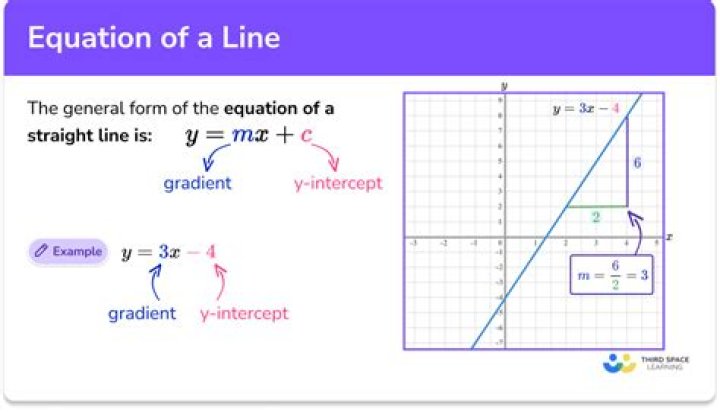
Just like we have the equation $y=mx+b$ for $\mathbb{R}^{2}$, what would be a equation for $\mathbb{R}^{3}$? Thanks.
$\endgroup$ 06 Answers
$\begingroup$Here are three ways to describe the formula of a line in $3$ dimensions. Let's assume the line $L$ passes through the point $(x_0,y_0,z_0)$ and is traveling in the direction $(a,b,c)$.
Vector Form
$$(x,y,z)=(x_0,y_0,z_0)+t(a,b,c)$$
Here $t$ is a parameter describing a particular point on the line $L$.
Parametric Form
$$x=x_0+ta\\y=y_0+tb\\z=z_0+tc$$
These are basically the equations that result from the three components of vector form.
Symmetric Form
$$\frac{x-x_0}{a}=\frac{y-y_0}{b}=\frac{z-z_0}{c}$$
Here we assume $a,b,$ and $c$ are all nonzero. All we've done is solve the parametric equations for $t$ and set them all equal.
$\endgroup$ 5 $\begingroup$You can describe a line in space as the intersection of two planes. Thus, $$\{(x,y,z)\in{\mathbb R}^3: a_1x+b_1y+c_1z=d_1 \text{ and } a_2x+b_2y+c_2z=d_2\}.$$ Alternatively, you can use vector notation to describe it as $$\vec{p}(t) = \vec{p}_0 + \vec{d}t.$$
I used this relationship to generate this picture:
This is largely a topic that you will learn about in a third semester calculus course, at least in the states.
$\endgroup$ 5 $\begingroup$When I originally asked this question, I was not expecting these seemingly indirect ways of describing a line, such as an intersection of two planes, or vector equations. Just like how $y=mx+b$ is the equation of a line in $2$D, I was expecting some sort of equation $z = f(x, y)$, where $f$ is some nice elementary function. I am writing this answer for anyone who has this same idea that I did. I want to quickly explain why the equation of a line cannot be $z = f(x, y)$, where $f$ is a nice function.
The problem is that if $f$ is a nice function, then it is probably defined for all pairs $(x, y)$, or almost all. That means that if you try to graph it, there will be a point of the graph of $f$ above almost every point of the floor, so the graph of $f$ cannot be a line.
Another way to say it is this: imagine the graph of the line. If we want an equation $f(x, y)$ for the line, the domain of $f$ can only be the shadow of the line on the $xy$ plane. But any nice function $f$ will have as a domain either all pairs $(x, y)$, or almost all of them.
With all of that being said, it is possible to cook up a function $f(x, y)$ whose graph is a line. We know that if we could take a plane, for example $g(x, y) = x+y$, and somehow restrict its domain to a line on the $xy$ plane, that would give us a line in $xyz$ space. Here is one way to do it:$$f(x, y) = x+y+\sqrt{-(y-x)^2}$$
The expression $-(y-x)^2$ is $\le 0$ for any $x, y$ and it equals zero precisely when $y = x$. Therefore $\sqrt{-(y-x)^2}$ will only be defined precisely when $y = x$, and when $y$ does equal $x$, $f(x, y) = x+y$. Thus the graph of $f$ is a line in 3D space.
$\endgroup$ 2 $\begingroup$I am giving you an example. Let $A(-2,0,1),~~B(4,5,3)$ be two points in $\mathbb R^3$. And let $C$ be the end point for the vector which is drawn from the origin. In addition, we assume that this vector has the same direction as the vector $AB$. So we have its coordinates is $(4,5,3)-(-2,0,1)=(6,5,2)$. Therefore the equation of the line passing through $A$ and $B$ is $$L_{AB}: x=(-2,0,1)+t(6,5,2)$$
$\endgroup$ 6 $\begingroup$I love your answer for a line equation in the form of z = f(x, y)... Unfortunately calculating square roots can be impractical from the calculational standpoint and hence I really doubt any plotting software will be able to graph it correctly.
I was thinking of a little bit different approach in order to achieve this. Based on a symmetric equation of a line. However it requires some support for if ... else logic.
$$z=if\:\left(\frac{x}{2}+1=\frac{y}{3}+2\right)\:then\left(\frac{x}{5}+3\right)\:else\left(undefined\right)$$
Of course the advantage here is that it's easy to read and you can potentially define any line in $R^3$ by changing the constant parameters. In practice though, even when conditional statements are supported, for example in GeoGebra - it still fails to actually draw the line.
$\endgroup$ $\begingroup$Besides the parametric form, another equation of a line in 3D to get it in the form $f(x,y,z)=0$ could be written as:$\frac{\mathbf{r}-\mathbf{r_0}}{|\mathbf{r}-\mathbf{r_0}|} \cdot \mathbf{n} = 1$
Here $\mathbf{r}=(x,y,z)$ is a vector representing any general point on the line. $\mathbf{r_0}=(x_0,y_0,z_0)$ is a given point that lies on the line. $\mathbf{n}=(n_x,n_y,n_z)$ is a given unit vector (that has a magnitude of unity) that is parallel to the line. If two separate points $\mathbf{r_1}$ and $\mathbf{r_2}$ are given through which the line passes, then we could write $\mathbf{n} = \frac{\mathbf{r_2}-\mathbf{r_1}}{|\mathbf{r_2}-\mathbf{r_1}|}$.
Written differently, the equation would read:$(x-x_0)n_x + (y-y_0)n_y + (z-z_0)n_z - \sqrt{(x-x_0)^2+(y-y_0)^2+(z-z_0)^2} = 0$
This is a quadratic equation in, say, $z$, in that a closed form solution could be written for $z$ in terms of $x, y$ and other given parameters. However, it is not easy to see that this equation should lead to a real solution for $z$ for only a specific subset of $x, y$ pairs on the $x-y$ plane.
$\endgroup$