What is the lagrange remainder for $\sin x$?
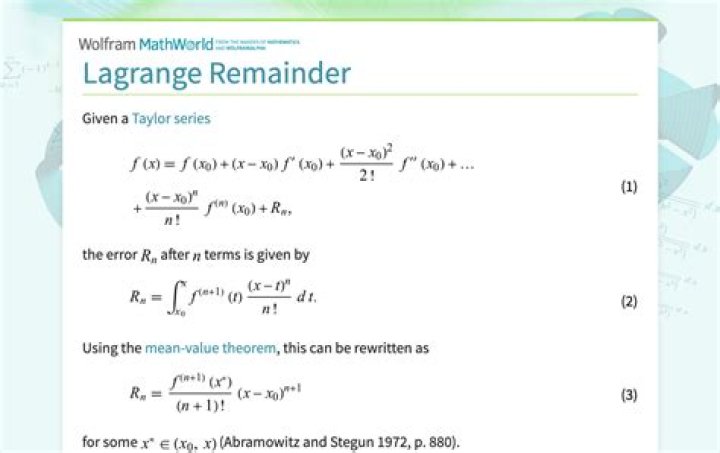
What is the lagrange remainder for $\sin x$?
$R_n=\frac{f^{n+1}(c)}{(n+1)!}x^{n+1}$ and
$$\sin x = \sum_{n=0}^{\infty}\frac{(-1)^n}{(2n+1)!}x^{2n+1}$$
So, is it
$$R_{2n+1}=\frac{f^{2n+2}(c)}{(2n+2)!}x^{2n+2}$$
or is it:
$$R_{n}=\frac{f^{n+1}(c)}{(n+1)!}x^{n+1}$$
I mean, how many derivatives should I calculate for $R_3$ for instance?
Thanks!
$\endgroup$1 Answer
$\begingroup$Although we write a compact shorthand for the Maclaurin series of $\sin(x)$, it still falls into the same category as everything else. The $n$th term is $\frac{a_n}{n!} x^n$ where $a_n=(-1)^{(n-1)/2}$ if $n$ is odd and $0$ if $n$ is even. As a result, the remainder of the degree $n$ Taylor polynomial from the Lagrange remainder would be $\frac{\sin^{(n+1)}(c)}{(n+1)!} x^{n+1}$.
However, if $n$ was odd, then the degree $n$ Taylor polynomial and the degree $n+1$ Taylor polynomial are the same because $a_{n+1}=0$. Thus you typically get a slightly better estimate by considering $\frac{f^{(n+2)}(c)}{(n+2)!} x^{n+2}$.
So one thing to be careful of here is whether you are asking for the remainder of "the degree $n$ Taylor polynomial" vs. "the Taylor polynomial with $n$ nonzero terms".
$\endgroup$