What is the relative maximum or minimum and the point of inflection?
$f(x) = ax^3+bx^2+cx +d$, determine a, b, c, and d such that the graph of $f$ has a extreme in $(0,3)$ and a point of inflection in $(-1,1)$.
When is a quadratic I know that the formula $V=(\frac{-b}{2a},\frac{-\triangle}{4a})$ gives the maximum or minimum of the function, but for $f(x) = ax^3+bx^2+cx +d$, not seems the same. I tried to make $f(x) = x(ax^2+bx+c) +d$ but doesn't work and for the point of inflection I know that is the point of the second derivative is equal zero and change of the signal, but how I can make the function change in (-1,1)?
$\endgroup$3 Answers
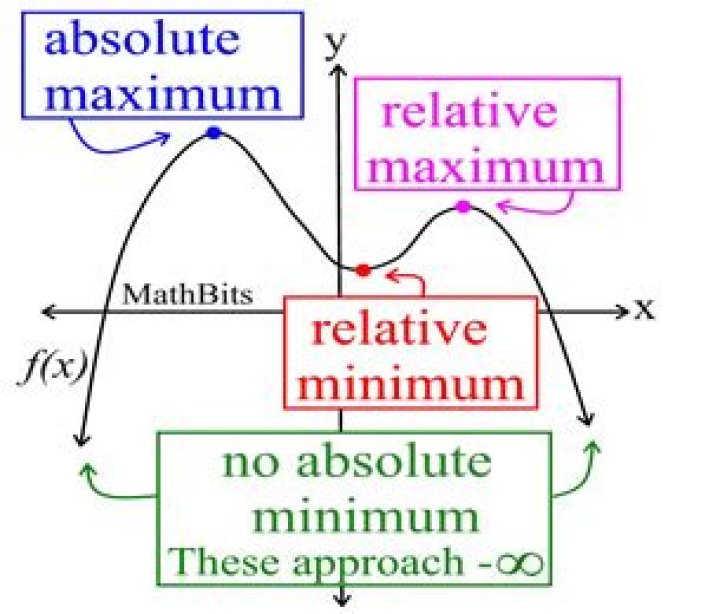
$\begingroup$An extremum on the graph is a point where the function is locally maximal or minimal, and occurs when $f'(x)=0$. A point of inflection is when the curvature changes sign, and occurs when $f''(x)=0$.
So, we know that \begin{align} f'(x)&=3ax^2+2bx+c,\\ f''(x)&=6ax+2b. \end{align} We want $f'(x)=0$ when $x=0$, and therefore we can see that $f'(x)_{x=0}=3a\cdot 0^2$ $+2b\cdot 0+c=c$, and therefore $c=0$. Also, we want $f''(x)=0$ when $x=-1$, and therefore we can see that $f''(x)_{x=-1}=-6a+2b=0$, and therefore $a=b/3$. So our function is now, $$f(x)=ax^3+3ax^2+d.$$ Now, when $x=0$, $f(x)=3$, so we see that $d=3$, and when $x=-1$, $f(x)=1$, and so $a=-1$, which gives the function $$f(x)=-x^3-3x^2+3.$$
However, to be more rigorous, you need to apply the first derivative test to each point under consideration to make sure that we are looking at a point of inflection, or a extremal point. Recall that the first derivative test says that: if $f(x)$ is continuous at a point $x_0$, then:
i) if $f'(x)>0$ on the left of $x_0$, and $f'(x)<0$ on the right of $x_0$, then we have a local maximum, ii) if $f'(x)<0$ on the left of $x_0$, and $f'(x)>0$ on the right of $x_0$, then we have a local minimum, iii) and if $f'(x)$ has the same sign on the left and the right of $x_0$, then we have a point of inflection.
$\endgroup$ 4 $\begingroup$Extremum at $(0,3)$:
We need $f'(0) = 0$ and $f''(0) \ne 0$ for a local minimum or maximum at $x=0$, so $$ f'(x) = 3ax^2 + 2bx + c \Rightarrow f'(0) = c = 0 \\ f''(x) = 6ax + 2b \Rightarrow f''(0) = 2b \ne 0 $$ then $f(0) = 3$ was required: $$ f(0) = d = 3 $$Inflection point at $(-1, 1)$:
Further we need $f''(-1) = 0$, because the curvature $$ k(x)= \frac{f''(x)}{(1+f'(x)^2)^{3/2}} $$ is required to change sign for a point of inflection, and it has the same sign as $f''$, so $$ f''(x) = 6ax + 2b \Rightarrow f''(-1) = -6a + 2b = 0 $$ and $f(-1) = 1$ was required: $$ f(-1) = -a + b -c + d = -a + b+3 = 1 $$ so we need to solve $$ -6a + 2b = 0 \\ -a + b + 3 = 1 $$ which is equivalent to $$ b = 3a \\ -a + 3a = -2 $$ which is equivalent to $$ a = -1 \\ b = -3 $$Checking the solution:
This gives $$ (a, b, c, d) = (-1, -3, 0, 3) $$ which is the function $$ f(x) = -x^3 - 3x^2 + 3 $$ It has the derivatives $$ f'(x) = -3x^2 -6x \\ f''(x) = -6x - 6 $$ with $f'(0) = 0$, $f''(0) = -6 \ne 0$, $f(0) = 3$, so we have a local maximum at $(0,3)$.
Further it has $f''(-1) = 0$, $f(-1) = 1$. Then we have for $\epsilon > 0$ $$ f''(-1 - \epsilon) = -6(-1-\epsilon) - 6 = 6 \epsilon > 0 \\ f''(-1 + \epsilon) = -6(-1+\epsilon) - 6 = -6 \epsilon < 0 $$ so we have a change of sign of $f''$ and thus also for the curvature $k$ around $x=-1$, which makes $(-1,1)$ a point of inflection.
You need to write four equations, since you have four unknowns $(a,b,c,d)$. Since $(0,3)$ is an extreme, you have two equations. The first one is that the $(0,3)$ is on the graph, the second is that the derivative is $0$. Once you figure out the solution, you must make sure it is indeed a minimum or maximum. For the other two equations, $(-1,1)$ is on the graph of the function, and the second derivative is $0$ at that point. Write out these equations, see if you can come up with some numbers for $(a,b,c,d)$.
I will start with $f(0)=3$, so $d=3$.
$\endgroup$More in general

"Zoraya ter Beek, age 29, just died by assisted suicide in the Netherlands. She was physically healthy, but psychologically depressed. It's an abomination that an entire society would actively facilitate, even encourage, someone ending their own life because they had no hope. Th…"

