What is this notation? Cyclic group $\mathbb{Z}^*_8$
$\mathbb{Z}^*_8$
As I understand it - $\mathbb{Z}_8$ is the group of integers under addition modulo 8.
So am I correct in thinking its elements are: $\{0,1,2,3,4,5,6,7\}$?
I thought the $*$ meant excluding zero, so I was confused to learn that the elements of $\mathbb{Z}^*_8$ are apparently: $\{1,3,5,7\}$ - missing $2$, $4$ and $6$.
The only possible answer I can think of is that because <1>,<3>,<5> and <7> can generate the whole group - $2$, $4$ and $6$ are omitted from $\mathbb{Z}_8$ in the first place, meaning $*$ does just remove the zero as I thought.
Can someone explain this to me as the notes I'm using aren't helping!
$\endgroup$ 34 Answers
$\begingroup$$\mathbb{Z_8}^*$ denotes the multiplicative group of $\mathbb{Z_8}$ as Mark Bennet has said.
You can show that $x \in \mathbb{Z_n}$ has a multiplicative inverse if and only if $(x,n)=1$. The proof is based on a special case of Bezout's theorem that states $(x,n)=1$ if and only if $\exists a,b \in \mathbb{Z}: ax+bn = 1$.
If $(x,n)=1$, then $\exists a,b: ax+bn=1$. This implies that $bn = 1-ax$ or $n \mid 1-ax$ which is the same as $ax \equiv 1 \pmod{n}$.
On the other hand, if there exists $a \in \mathbb{Z_n}$ such that $ax \equiv 1 \pmod{n}$ then $\exists b \in \mathbb{Z}: bn = 1 - ax$. Which gives you the converse.
So, the necessary and sufficient condition for an element in $\mathbb{Z_n}$ to be invertible is that it is relatively prime to $n$.
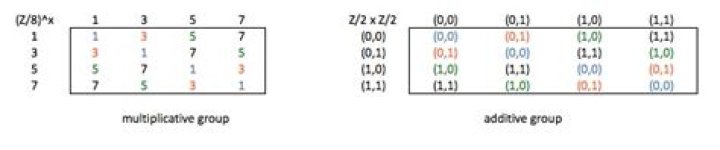
$\endgroup$ 2 $\begingroup$Taking the elements coprime with n means those who have no common prime factor with n. This means we take only those who have an inverse (and are not zero divisors, which is saying the same thing dealing with finite groups). In the first example with $\mathbb{Z}/8$ , we keep the classes representatives as 1, 3, 5, 7 and make them into a abelian multiplicative group named $\mathbb{Z}^*_8$ . Some use an *, others like Andrew Baker from University of Glasgow use a x. He would write $(\mathbb{Z}/8)^×$. There is a group isomorphism with $\mathbb{Z}^*_8$ and $\mathbb{Z}/2$ x $\mathbb{Z}/2$.
This shows the isomorphism:
This is a notational device. The $^*$ is being used to show that the group operation is multiplication, and the elements of the group are the elements of $\mathbb Z_8$ which are coprime to $8$. The identity is $1$.
The integers taken modulo $n$ inherit both addition and multiplication from $\mathbb Z$. If you take the elements coprime to $n$ you get a multiplicative group of order $\varphi (n)$ whose elements satisfy $$x^{\varphi(n)}=1$$This is the Euler-Fermat theorem, a generalisation of Fermat's Little Theorem.
$\endgroup$ 1 $\begingroup$The $^*$ only means "excluding zero" when you have a field $\Bbb F$: in that case the nonzero elements form a group under multiplication.
In the (more general) case of a ring $\mathcal R$, the group of units (invertible elements under multiplication) can be denoted by $\mathcal R^*,\mathcal R^×$ or $U(\mathcal R)$. Sometimes you see $U(n)$ or $U_n$.
So, since $\Bbb Z_8$ is a ring, but not a field, $\Bbb Z_8^*$ refers to the $\varphi (8)=4$ elements of $\Bbb Z_8$ invertible under multiplication. (Here $\varphi $ is Euler's totient function). Namely, those that are relatively prime to $8$.
Gauß knew that $\Bbb Z_n^*$ is cyclic when (and only when) $n=1,2,4$, a power of an odd prime, or $2$ times a power of an odd prime.
Thus, $\Bbb Z_8^*$ is not cyclic. Since its order is $4$, and it's abelian, it follows that it's isomorphic to the Klein four group.
$\endgroup$More in general
‘Cutter’s Way’ (March 20, 1981)

