When does a line integral equal an ordinary integral?
I was working through a proof, and it changed a line integral into a normal integral. It was analogous to the below, where $\cos(\theta)\,dl=dr$ and $C$ is a path from $b$ to $a$:$$\int_C F(r)\cos(\theta)\,dl=\int^{r_a}_{r_b} F(r)\,dr$$Why is this valid, i.e. why does the second integral not depend on the path taken? It would seem to me that it should, if say we kept increasing and decreasing $r$ along the same path, this might have an effect on the integral. So why in this situation can we go from a line integral to a normal integral?
$\endgroup$ 22 Answers
$\begingroup$First, "normal" integrals are "path-independent" by definition. When you convert the line integral to the second integral you have on the right hand side,
$$ \int_{r_a}^{r_b} F(r) dr \hspace{10pt} ,$$
you're saying that the original line integral, whose path is prescribed by C, is equivalent to a "normal" 1-D integral that we can interpret in the sense of Riemann rectangles. That is, we're looking at the area under the function $F(r)$.
I hope that this notion is clear to you -- the notion of why integrals like $\int_0^5 x^2 dx$ can only achieve one value. The "area under the curve" definition is relatively unambiguous in that it doesn't have to refer to any "paths".
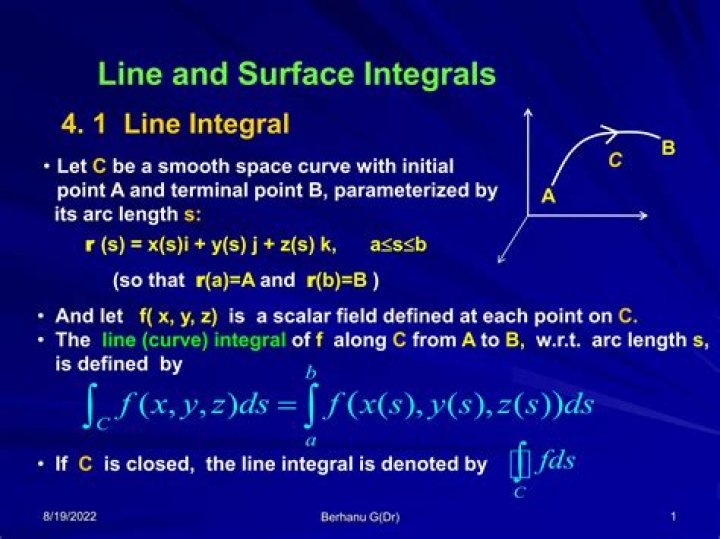
As for why it is legal for us to make this "conversion" from a line integral to an "area-under-the-curve" integral, I would think of it this way. A line integral is of the form $$\int_C \boldsymbol{F}(\boldsymbol{r}) \cdot d\boldsymbol{r}$$ Like the "area-under-the-curve" integral, you're really just adding something up. For each step $ds$ you take on the curve $C$, you add the infinitesimal quantity $\boldsymbol{F}(\boldsymbol{r}) \cdot d\boldsymbol{r}$ that is associated with a step $ds$. In "area" under the curve" integrals, you add up the area associated with each piece of $dx$ as you move along the $x$-axis.
The calculation of this integral requires a parametrization (common choices for parameterization would be the $x$ coordinate or the time $t$), in order to define what your step $ds$ looks like. In the example you gave, an arbitrary variable $r$, is used as the parameter. This parameter can be anything, as long as it produces a one to one mapping from a 1D interval $[r_a,r_b]$ to your curve $C$. That is, every value $r$ is associated with a unique point along your curve $C$ and every little infinitesimal interval $dr$ is uniquely associated with some piece $ds$ along the curve $C$.
So, what you're really doing is looking at the problem in a simpler light. You're transforming coordinates in a sense to make your curve truly "one-dimensional."
I hope everything I've said up to this point justifies why you can convert a path integral to a "normal"/"area under the curve" integral.
Now, there seems to be another point that is stumping you conceptually. "Why is this valid, i.e. why does the second integral not depend on the path taken? It would seem to me that it should, if say we kept increasing and decreasing r along the same path, this might have an effect on the integral."
(I think the other answer given misinterpreted what you were saying a little bit. When people say "path-independent" in calculus, they usually mean that it doesn't matter what path you take between two points. In your case, you've fixed the path $C$ and you're asking why, if you suddenly decide to turn around and retrace your steps before continuing onto your eventual destination, this doesn't change the integral.)
Again, let's look at how the line integral is defined: $$\int_C \boldsymbol{F}(\boldsymbol{r}) \cdot d\boldsymbol{r}$$ This is the line integral in its true form. Any line integral can be written this way, even those of the form $$\int_C F(r) ds$$ The $d\boldsymbol{r}$ should be thought of as a vector pointing in the direction you're going. $\boldsymbol{F}(\boldsymbol{r})$ is the value of your vector function at the point $\boldsymbol{r}$, and is the same regardless of which direction you're traversing the path $C$. The $d\boldsymbol{r}$ associated with going "backward" would be opposite in sign to the $d\boldsymbol{r}$ associated with going "forward". Thus, the sign of $\boldsymbol{F}(\boldsymbol{r}) \cdot d\boldsymbol{r}$ is flipped when you go "backward" instead of "forward". This means that when you retrace your steps, you subtract away all the $\boldsymbol{F}(\boldsymbol{r}) \cdot d\boldsymbol{r}$ that you added to your running total.
One way to see this is that if you do a line integral over $C$ going one way, you will get the negative result integrating it going the other way. Let's say the end points of $C$ are $A$ and $B$. The integral going from $A$ to $B$ along $C$ would be negative the integral going from $B$ to $A$ along $C$. Thus, the net result from going $A$ to $B$ along $C$ and then from $B$ to $A$ along $C$ would be zero.
I hope this is clear, please let me know if there are other points to clarify.
$\endgroup$ 1 $\begingroup$If ${\bf F}$ is the gradient of some scalar $\phi$ (i.e., if ${\bf F}$ is conservative) then $$\int_C {\bf F}\cdot d{\bf r} = \int_a^b \nabla\phi \cdot {\bf r}'(t) dt = \int_a^b \frac{d \phi}{dt} dt = \phi(b)-\phi(a),$$ since $d\phi({\bf r}(t))/dt = \nabla\phi \cdot {\bf r}'(t)$. The line integral depends only on the value of $\phi$ at the endpoints. This is what is meant by the statement that a line integral is independent of path.
$\endgroup$ 4