Why do Dummit & Foote require an ideal also be a subring?
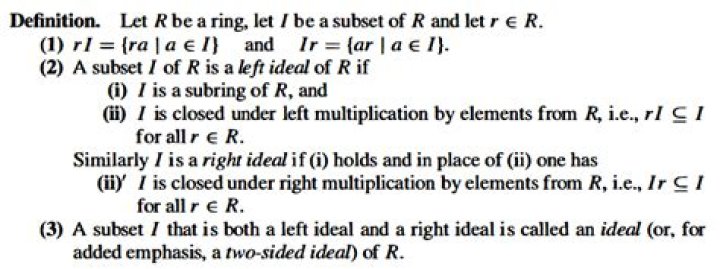
On page 242 of Abstract Algebra, 3rd Ed., by Dummit & Foote, they write:
However, in my lecture notes, there is a line that says
Definition. (Ideal.) Let $R$ be a ring. A subgroup $I$ of the underlying abelian group $R$ is called an ideal if $rx \in I$ for all $r \in R, x \in I$.
Note that $I$ may not contain [the multiplicative identity], so it may not be a subring. In fact, if $1 \in I$, then $I$ must be the whole ring!
Surely this is a typo in Dummit and Foote, right? Like my lecture notes suggest, if $1 \in I$ then $I = R$ since $r \in I$ for all $r \in R$.
Wikipedia seems to agree that an ideal need not be a subring.
EDIT: I realised Dummit & Foote doesn't require a subring to include the multiplicative identity. This answers my original question, but begs a new one: why would D&F define a subring to not necessarily be itself a ring?
$\endgroup$ 41 Answer
$\begingroup$As the comments on the original post suggested, the book by Dummit & Foote does not require rings to be unital (contain a multiplicative identity). Naturally — and to answer the question in the edit — subrings need not be unital rings either, according to Dummit and Foote.
$\endgroup$ 1