With regards to vector spaces, what does it mean to be 'closed under addition?'
My linear algebra book uses this term in the definition of a vector space with no prior explanation whatsoever. It proceeds to then use this term to explain the proofs.
Is there something painfully obvious I'm missing about this terminology and is this something I should already be familiar with?
The proof uses $u + v$ is in $V$
$\endgroup$5 Answers
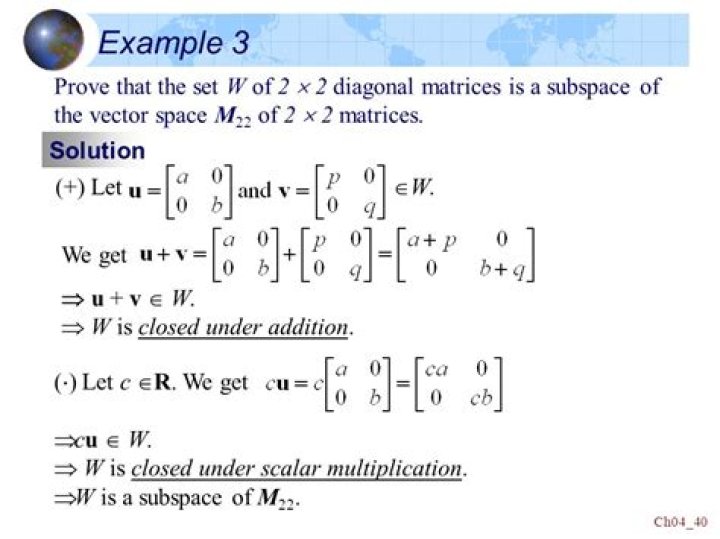
$\begingroup$Let $V$ be a set with a function $f:V \times V \to V$. We call $f$ a binary operation on $V$ because it takes two elements of $V$ and gives us another element on $V$. We say a subset $U$ of $V$ is closed under the binary operation $f$ if for every pair of elements $u_1$ and $u_2$ in $U$, we have $f(u_1,u_2)\in U$.
In your example you would take $f$ to be the addition function $f(a,b)=a+b$ (exactly what "addition" means will depend on context). So a set is closed under addition if the sum of any two elements in the set is also in the set.
For example, the real numbers $\mathbb{R}$ have a standard binary operation called addition (the familiar one). Then the set of integers $\mathbb{Z}$ is closed under addition because the sum of any two integers is an integer. The set of odd integers is not because, for example, $3+3=6$ which is not odd.
$\endgroup$ 2 $\begingroup$Sometimes it's easiest to understand a definition by finding objects that don't satisfy the definition. Let me show you a few sets that are not closed under addition. (A set $S$ is "closed under addition" if whenever you pick two elements of $S$, their sum is again in $S$.)
- The set $S=\{1,2,3\}$ is not closed under addition because $2$ and $3$ are in $S$ but $2+3=5$ is not in $S$.
- The set $S=\{1\}$ is not closed under addition because $1$ and $1$ are in $S$ but $1+1=2$ is not in $S$. (So we can pick the same point twice.)
- Along the lines of the previous two examples, any finite set of real numbers except for $\{0\}$ or $\varnothing$ is not closed under addition.
- The circle of radius $1$ centered at the origin (which consists of points $(x,y)$ where $x^2+y^2=1$) is not closed under addition because, for example, $(0,1)$ and $(0,-1)$ lie on the circle but $(0,1)+(0,-1)=(0,0)$ does not.
Why is the "closed under addition" property useful in linear algebra? As the name suggests, linear algebra is the study of objects that you can add together and multiply by scalars -- vectors -- which live in vector spaces. It would be problematic for a vector space to not be closed under addition since that would violate the "linear" part of linear algebra.
$\endgroup$ $\begingroup$If a set of vectors is closed under addition, it means that if you perform vector addition on any two vectors within that set, the result is another vector within the set.
For instance, the set containing vectors of the form $<x, 2x>$ would be closed under vector addition. Adding two arbitrary vectors from this space, say $<x_1, 2x_1> + <x_2, 2x_2>$, results in $<x_1+x_2, 2(x_1+x_2)>$, which is also in the vector space (let $x = x_1+x_2$).
However, the set containing vectors of the form $<1, x>$ would not be closed under vector addition (add two arbitrary vectors from the set and you'll see that the resulting vector is $<2, x_1+x_2>$, which is not in the set, as $1\neq2$).
$\endgroup$ $\begingroup$It means if you add two vectors you definitely get another vector (and not something different we might call a spectre ...). i.e. addition works.
$\endgroup$ 3 $\begingroup$Consider the collection of points that literally lie on the $x$-axis or on the $y$-axis. We could still use Cartesian vector addition to add two such things together, like $(2,0)+(0,3)=(2,3)$, but we end up with a result that is not part of the original set. So this set is not closed under this kind of addition.
If addition is defined at all on a set, to be closed on that set, the result of an addition needs to still be in that set.
$\endgroup$