logistic differential equation, carrying capacity.
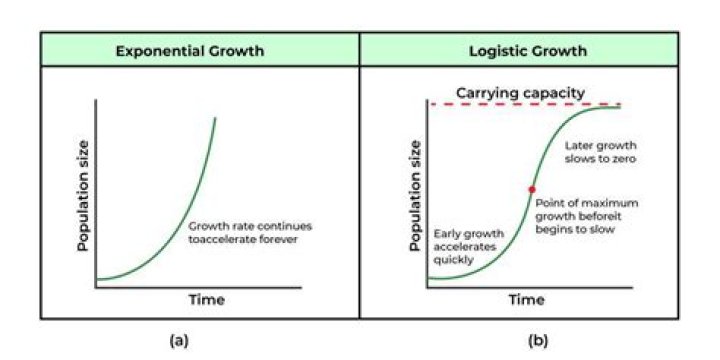
Assume that a population grows according to the below logistic differential equation $$\frac{\mathrm{dP} }{\mathrm{d} t}=0.01P-0.0002P^2$$Then what is the maximum population that this model holds?
I think the answer is 50000(I can be wrong!!). Can anyone show me the steps of how to do this? using direction fields? or solve the differential equation directly? and then how do you get the maximum population? Thank you.
$\endgroup$ 61 Answer
$\begingroup$This equation is separable. It is also a Ricatti equation (thus linearisable) if you are interested. We have$$\frac{dP}{dt} = aP(1-bP) \implies \int\frac{dP}{P(1-bP)} = \int a\,dt$$where $a=\frac{1}{100}$ and $b=\frac{1}{50}$. By partial fractions$$\frac{1}{P(1-bP)} = \frac{1}{P} + \frac{b}{1-bP}$$and substituting into the integral$$\ln|P|-\ln|1-bP| = at+c \implies \frac{P}{1-bP} = Ce^{at}$$where $c$ is a constant of integration and $C=\pm e^c$. Rearranging we get$$P=\frac{Ce^{at}}{1+bCe^{at}} = \frac{Ce^{\frac{1}{100}t}}{1+\frac{1}{50}Ce^{\frac{1}{100}t}} = 50\frac{Ce^{\frac{1}{100}t}}{50+Ce^{\frac{1}{100}t}} = \frac{50}{Ae^{-\frac{1}{100}t}+1}$$for some arbitrary $A=\frac{50}{C}$. Thus the long run population is $P\to 50$.
Note also that $P\equiv 0$ is a solution to the equation. Assuming that $0<P_0<50$, then the solution monotone increases from $P_0$ to $50$.
$\endgroup$ 7