mapping / projection onto axis
I have very basic question. In the Linear Algebra and Its Applications by Lay gives a definition of the mapping. The author also says that $[0,0; 0,1]$ is not a map between $\mathbb{R}^n$ and $\mathbb{R}^m$. Can you please elaborate why? Suppose I had a vector $[1,1]$. After the mapping it became $[1,0]$. Why this does not satisfy the mapping rule? Is this a direct consequence of the fact that the transformation matrix is singular? So, will this always be the case for singular matrix?
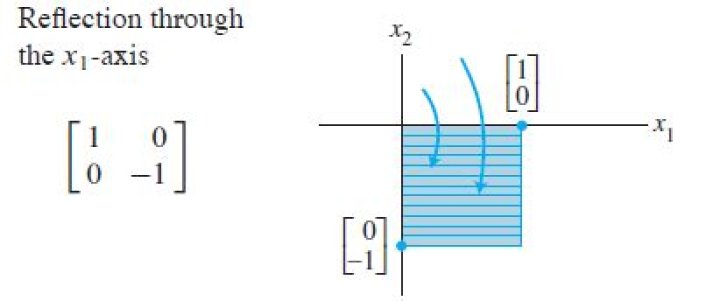
Update: Here is verbatim what was said in the book (Table 4 is a figure below):
Update 1:
Here is the example that satisfies ONTO mapping from $\mathbb{R}^2$ and $\mathbb{R}^2$
about the "onto" term:
Thanks
1 Answer
$\begingroup$Note that the linear map $$ \begin{bmatrix} 0&0\\0&1 \end{bmatrix} $$ which takes vectors from $\mathbb{R}^2\to \mathbb{R}^2$. What vector in $\mathbb{R}^2$ gets mapped to $\begin{bmatrix} 1\\0\end{bmatrix}$?
Taking $b=\begin{bmatrix} 1\\0\end{bmatrix}$ does the mapping satisfy the definition of being onto? Indeed, it should be clear from the geometric interpretation that any vector of the form $$ \begin{bmatrix} a\\0\end{bmatrix} $$ won't be mapped to by the projection.
$\endgroup$ 2